


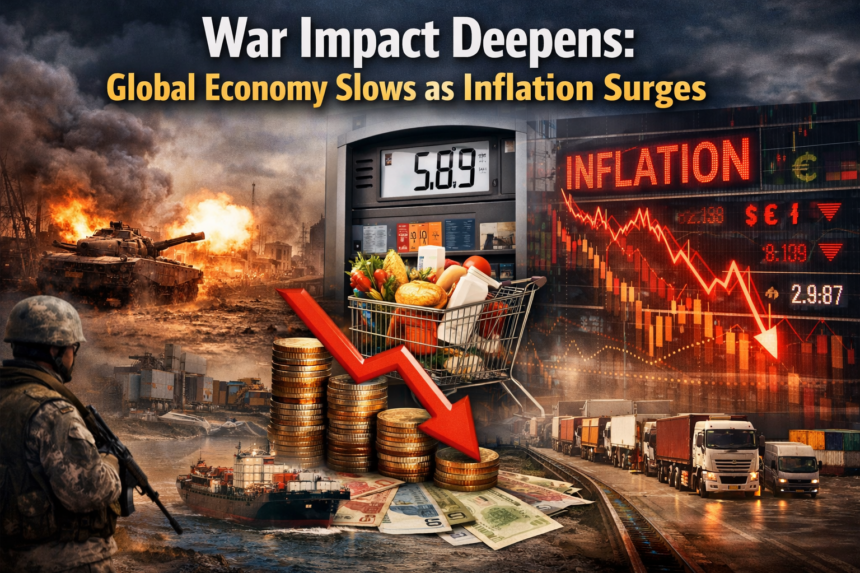
The ongoing war situation across key global regions is beginning to show serious consequences for the world economy. What initially appeared to be a geopolitical conflict has now turned into a major economic challenge, impacting countries far beyond the battlefield.
One of the most immediate effects of the war has been a slowdown in economic growth. Businesses are facing uncertainty due to unstable markets, disrupted trade routes, and rising operational costs. Investors are becoming cautious, leading to reduced investments and slower expansion across industries. As a result, many economies are struggling to maintain their growth momentum.
At the same time, inflation is rising sharply. The war has disrupted global supply chains, especially in energy, food, and raw materials. Fuel prices have surged due to limited supply and increased transportation costs. This directly affects everything from manufacturing to daily commuting, increasing the overall cost of living for common people.
Food prices have also been hit hard. Countries that depend on imports are facing shortages and higher costs, leading to pressure on household budgets. Essential goods are becoming more expensive, and in some regions, scarcity is starting to become a concern.
Another major issue is the impact on currency and financial markets. Stock markets have shown increased volatility, while some currencies are weakening under economic pressure. Central banks are forced to take strict measures, such as increasing interest rates, to control inflation. However, these steps can further slow down economic activity and affect employment.
For developing countries, the situation is even more challenging. Rising import bills, especially for fuel and food, are putting pressure on government finances. This may lead to increased borrowing and higher debt levels, creating long-term economic risks.
Experts warn that even if the war situation stabilizes in the near future, its economic effects may last for years. Recovery will depend on how quickly supply chains can be restored and how effectively governments manage inflation and growth.
In conclusion, the war is no longer just a political or military issue—it has become a global economic crisis. Rising inflation and slowing growth are affecting millions of people worldwide, making it clear that the cost of conflict extends far beyond the battlefield.