


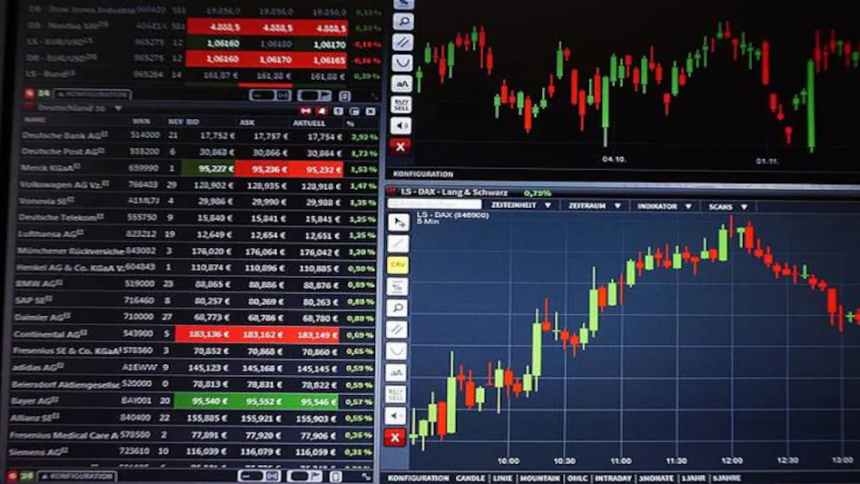
The Indian stock market ended on a cautious note as benchmark indices witnessed volatile trading throughout the session, eventually closing almost flat. Both the BSE Sensex and the NSE Nifty 50 fluctuated between gains and losses during the day, reflecting mixed investor sentiment driven by global cues, sectoral rotation, and profit booking at higher levels.
Market Overview: Range-Bound Yet Volatile Session
The trading day was marked by sharp intraday swings as investors remained cautious ahead of key economic signals and global market trends. Despite a positive opening, the indices struggled to hold gains due to selling pressure in select heavyweight stocks.
While banking and IT stocks showed resilience at intervals, declines in select consumer and retail stocks dragged the indices down, resulting in a flat closing. Analysts noted that the market is currently in a consolidation phase after recent rallies, with investors adopting a “wait-and-watch” strategy.
BEL Emerges as a Top Gainer
Shares of Bharat Electronics Limited (BEL) stood out as one of the top performers of the session. The stock witnessed strong buying interest backed by positive sentiment in the defence sector and expectations of robust order inflows.
Investors showed confidence in defence stocks due to:
- Strong government focus on domestic manufacturing
- Increasing defence budget allocations
- Consistent order book growth
Market experts believe BEL’s steady fundamentals and long-term growth outlook continue to attract institutional and retail investors alike.
Trent Faces Selling Pressure
On the flip side, Trent Limited ended the session in the red, emerging as one of the key laggards. The stock saw profit booking after recent gains, as investors turned cautious in the retail segment amid valuation concerns.
The decline in Trent reflects a broader trend where investors are selectively booking profits in high-performing consumption stocks. Weak sentiment in the retail sector and short-term market volatility also contributed to the downward movement.
Sectoral Performance: Mixed Trends Dominate
Sector-wise performance remained mixed:
- Defence and PSU stocks showed strength
- IT and banking remained largely stable
- FMCG and retail witnessed mild selling pressure
- Midcap and smallcap stocks traded with stock-specific action
This divergence indicates that investors are rotating funds across sectors instead of taking aggressive directional bets.
Global Cues and Investor Sentiment
Global market trends played a significant role in shaping domestic market movement. Mixed signals from international markets, fluctuating crude oil prices, and cautious foreign institutional investor (FII) activity kept volatility high.
Additionally, currency movements and inflation concerns added to investor uncertainty, preventing a strong breakout in either direction.
Technical Outlook: Consolidation Phase Continues
From a technical perspective, analysts suggest that Nifty is currently trading in a narrow range, indicating consolidation after recent highs. Key support and resistance levels are being closely watched by traders:
- Immediate support near recent swing lows
- Resistance near short-term highs
- Breakout above resistance may trigger fresh rally
Market experts advise investors to remain cautious and avoid aggressive leveraged positions during volatile sessions.
What Investors Should Watch Next
Going forward, market direction will depend on:
- Global economic data and US market trends
- RBI policy outlook and inflation data
- Corporate earnings announcements
- FII and DII investment flows
Stock-specific action is expected to remain strong, especially in defence, infrastructure, and PSU sectors.
Conclusion
In summary, the stock market closed flat after a volatile trading session, highlighting investor caution amid mixed global and domestic cues. While BEL’s strong performance provided support to the indices, declines in Trent and select heavyweights balanced out the gains.
The current market trend suggests consolidation with intermittent volatility, and investors are advised to focus on fundamentally strong stocks, maintain diversification, and adopt a long-term investment strategy rather than reacting to short-term market fluctuations.