


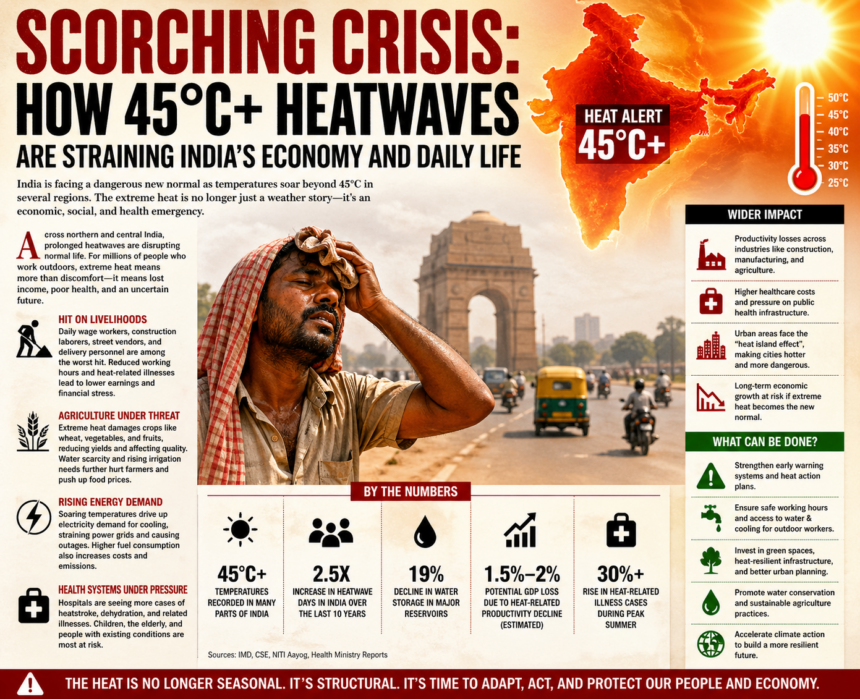
India is once again grappling with extreme heat conditions, as temperatures in several regions soar beyond 45°C. What was once considered an occasional summer spike is now becoming a recurring and intensifying pattern, raising serious concerns about its impact on the country’s economy, infrastructure, and the well-being of millions.
Across northern and central parts of India, prolonged heatwaves are disrupting normal life. Streets that are usually bustling during the day appear deserted, with people forced indoors to escape the scorching sun. For daily wage workers, however, staying indoors is not an option. Construction laborers, delivery personnel, and street vendors are among the worst affected, as their income depends entirely on working outdoors. Reduced working hours due to extreme heat directly translate into lost wages, deepening financial stress for vulnerable communities.
The economic impact of such high temperatures extends far beyond individual livelihoods. Productivity losses are becoming increasingly evident across sectors. Industries that rely heavily on manual labor, such as construction, agriculture, and manufacturing, are seeing slower output. Workers experience fatigue, dehydration, and heat-related illnesses, which lowers efficiency and increases absenteeism.
Agriculture, a backbone of India’s economy, is particularly vulnerable. Crops like wheat, vegetables, and fruits suffer under extreme heat, leading to lower yields and compromised quality. This not only affects farmers’ incomes but also contributes to rising food prices in urban areas. Water scarcity further worsens the situation, as reservoirs dry up and irrigation demands increase.
Energy demand also surges during heatwaves, as households and businesses rely heavily on air conditioning and cooling systems. This leads to higher electricity consumption, putting pressure on power grids. In some areas, this results in outages, disrupting both domestic life and industrial operations. Increased fuel consumption for power generation also adds to economic costs and environmental concerns.
Healthcare systems face an additional burden during such extreme weather events. Hospitals report a rise in cases of heatstroke, dehydration, and related complications. Vulnerable groups such as the elderly, children, and those with pre-existing conditions are at higher risk. Public health infrastructure, already stretched in many regions, struggles to cope with the sudden spike in patients.
Urban areas are particularly affected due to the “heat island” effect, where concrete structures trap heat, making cities significantly hotter than surrounding rural regions. This intensifies discomfort and increases health risks, especially in densely populated areas with limited green cover.
Experts warn that if these heatwaves continue to intensify, the long-term economic consequences could be severe. Reduced labor productivity, declining agricultural output, increased healthcare costs, and higher energy demand could collectively slow economic growth. Climate scientists emphasize the need for immediate adaptation strategies, including better urban planning, improved water management, and heat-resilient infrastructure.
At the policy level, there is a growing call for stronger climate action and preparedness plans. Early warning systems, public awareness campaigns, and protective measures for workers—such as adjusted working hours and access to cooling facilities—are being highlighted as essential steps.
As India faces rising temperatures year after year, the challenge is no longer just about coping with the heat. It is about safeguarding livelihoods, stabilizing the economy, and protecting public health in an increasingly warming world.