


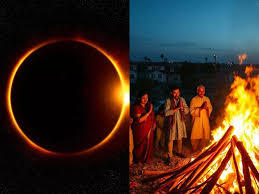
The first Lunar Eclipse (Chandra Grahan) of 2026 is taking place on 3 March 2026, coinciding with the Hindu festival season around Holi. This celestial event has generated huge interest among skywatchers, astrologers, and devotees across India. The eclipse occurs when the Earth comes between the Sun and the Moon, casting its shadow on the Moon and causing it to darken or appear reddish, often called a “Blood Moon.”
Below is the complete guide including date, time, Sutak kaal, rituals, mantras, and visibility in India.
Date and Timing of Lunar Eclipse 2026
The lunar eclipse will occur on Tuesday, 3 March 2026. According to astronomical calculations, the eclipse will begin in the afternoon and end in the evening.
Important timings (IST):
| Event | Time |
|---|---|
| Eclipse begins | 3:20 PM |
| Maximum eclipse | Around 5:03 PM |
| Total phase ends | 5:32 PM |
| Eclipse ends | 6:47 PM |
The moon will rise around 6:26 PM in many Indian cities, so people may see the ending part of the eclipse after moonrise.
Will the Lunar Eclipse Be Visible in India?
Yes, the Chandra Grahan 2026 will be partially visible in India. However, because the Moon rises after the eclipse has already started, most places in India will only see the last phase of the eclipse after moonrise.
-
Partial visibility across many parts of India
-
Better visibility in eastern and north-eastern regions
-
Western parts may see only a small portion of the eclipse
Globally, the eclipse will also be visible across Asia, Australia, and parts of the Americas.
Sutak Kaal of Chandra Grahan 2026
In Hindu traditions, Sutak Kaal is considered a spiritually sensitive period before an eclipse.
For the 3 March 2026 lunar eclipse:
-
Sutak begins: around 6:20 AM
-
Sutak ends: around 6:46 PM
During Sutak, many people avoid cooking, eating, or starting new activities. Religious practices such as meditation, mantra chanting, and prayers are encouraged.
Religious Significance of Lunar Eclipse
In Indian culture, lunar eclipses are linked with mythological stories involving Rahu and Ketu, two shadow planets believed to swallow the Moon temporarily. According to mythology, this belief originates from the story of the Samudra Manthan, where Rahu tried to drink the nectar of immortality and was punished by Lord Vishnu.
Although modern science explains eclipses as astronomical events, many people still follow traditional rituals during this time.
Rituals to Follow During Chandra Grahan
Many devotees follow specific rituals during the eclipse period.
Before the Eclipse
-
Take a bath and start prayers
-
Avoid cooking fresh food
-
Keep Tulsi leaves in food items
During the Eclipse
-
Chant mantras or meditate
-
Avoid eating or drinking
-
Stay indoors and avoid starting new work
After the Eclipse
-
Take a bath again
-
Clean the house and temple area
-
Donate food or clothes to the needy
These rituals are believed to bring spiritual purification and positive energy.
Mantras to Chant During Lunar Eclipse
Many spiritual texts suggest chanting powerful mantras during the eclipse.
Popular mantras include:
-
Om Namah Shivaya
-
Om Chandraya Namah
-
Maha Mrityunjaya Mantra
-
Gayatri Mantra
Devotees believe that chanting these mantras during the eclipse can increase spiritual benefits and remove negative energy.
Safety Tips for Watching the Lunar Eclipse
Unlike solar eclipses, lunar eclipses are completely safe to watch with the naked eye. No special equipment is required.
Tips to enjoy the view:
-
Watch from open areas such as terraces or rooftops
-
Use binoculars or telescopes for a better view
-
Avoid city lights for clearer observation
Conclusion
The Lunar Eclipse on 3 March 2026 is a rare and exciting astronomical event that coincides with the Holi festival period. While science explains it as a natural celestial alignment, many people in India also observe traditional rituals and prayers during the eclipse. With partial visibility across the country, skywatchers will still have a chance to witness this fascinating cosmic phenomenon.