


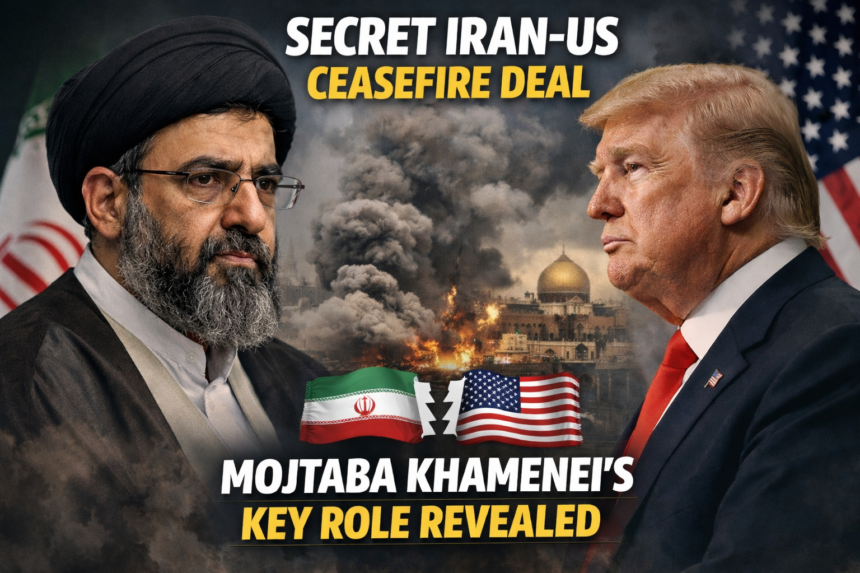
A surprising new report has revealed that Iran’s largely unseen Supreme Leader, Mojtaba Khamenei, played a crucial behind-the-scenes role in securing a temporary ceasefire agreement with the United States, despite ongoing uncertainty about his public presence and health.
According to recent reports, the ceasefire deal—agreed upon after weeks of escalating conflict—was not just the result of open diplomatic channels, but also of covert negotiations directed from within Iran’s top leadership. Mojtaba Khamenei, who has not been seen publicly for weeks, reportedly instructed key negotiators through indirect communication methods due to security concerns.
The agreement led to a temporary two-week truce between Iran and the United States, offering a brief pause in a conflict that had threatened to spiral into a wider regional war. US President Donald Trump was said to have coordinated the deal with regional allies, including Israel, before announcing the ceasefire.
Despite the breakthrough, the situation remains highly fragile. Iranian leadership has made it clear that the ceasefire does not mark the end of hostilities. In official statements, Khamenei reportedly warned that the pause in fighting should not be interpreted as a sign of peace, but rather a temporary tactical move.
Adding to the intrigue, conflicting reports continue to circulate about Khamenei’s condition. Some intelligence sources suggest he has been seriously injured and may be unable to actively participate in decision-making, raising questions about how much direct control he exercised during the negotiations.
Earlier in the conflict, Khamenei had taken a hardline stance, reportedly rejecting ceasefire proposals and insisting on strong retaliation against both the United States and its allies. However, more recent developments indicate a shift toward controlled de-escalation, possibly driven by mounting military and economic pressure.
The ceasefire also comes with conditions. Iran is expected to take steps such as reopening critical shipping routes like the Strait of Hormuz, while both sides prepare for further talks that could determine whether a longer-term agreement is possible.
While the truce offers a moment of relief to the international community, analysts warn that deep mistrust between Washington and Tehran remains unresolved. With mixed signals from Iran’s leadership and uncertainty surrounding Khamenei’s actual role, the path toward lasting peace is still unclear.