


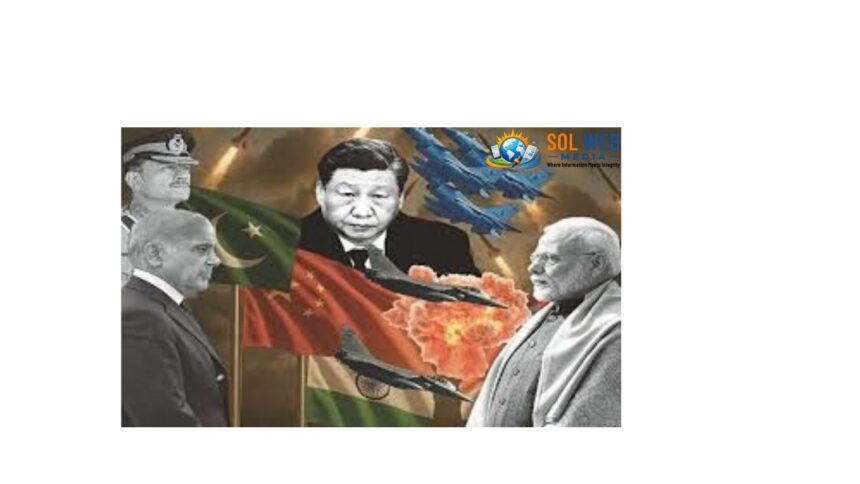
Escalating hostilities in the Middle East involving United States, Israel, and Iran are no longer distant developments that concern only regional players. The aftershocks are being felt across continents, influencing energy markets, trade corridors, and the strategic calculations of major Asian powers. Among those watching with sharpened focus are China, Pakistan, and India – three neighbours whose futures are increasingly shaped by events far beyond their borders.
At the heart of the matter lies energy security. The Middle East remains the lifeline of global oil supply, and any hint of instability immediately unsettles markets. For China and India – two of the world’s fastest-growing major economies – uninterrupted access to energy resources is not merely an economic requirement but a national priority. A disruption in supply chains or strategic sea routes can slow factories, raise inflation, and strain government finances.
China’s stakes are particularly high. As the world’s largest crude oil importer, Beijing has invested heavily in cultivating strong economic relationships across the Gulf. Its approach, however, differs from traditional power politics. Rather than projecting military force, China advances its interests through infrastructure funding, trade expansion, and long-term development agreements. Highways, ports, pipelines, and industrial zones built under its global connectivity projects now tie Beijing’s economic future closely to Middle Eastern stability.
Yet China’s strategy is a delicate balancing act. It maintains close economic cooperation with Iran while simultaneously expanding trade partnerships with Saudi Arabia and other Gulf monarchies. This multi-directional diplomacy allows Beijing to avoid direct entanglement in regional rivalries – but only as long as tensions remain contained. A wider conflict could place Chinese investments, energy routes, and diplomatic neutrality under serious strain.
For Pakistan, the crisis presents a different set of challenges. Geography places it closer to potential flashpoints, with a long and sensitive border adjoining Iran. Any deterioration in regional security risks spilling over into border provinces, disrupting trade links and complicating internal stability.
Economic realities further complicate Islamabad’s position. Pakistan depends heavily on Gulf nations for energy imports, financial assistance, and employment opportunities for millions of its citizens. Remittances sent home by overseas workers form a crucial support system for the national economy. If tensions escalate into a broader regional confrontation, Pakistan may find it increasingly difficult to maintain a neutral diplomatic posture without jeopardizing key relationships.
Adding another layer to this equation is Pakistan’s deep strategic partnership with China. Infrastructure and energy projects connecting western China to the Arabian Sea have elevated Pakistan’s geopolitical importance. These routes provide Beijing with alternative access to global trade corridors, reducing its reliance on longer and potentially vulnerable maritime paths. In times of uncertainty, such connectivity becomes strategically invaluable.
India, meanwhile, confronts a complex strategic landscape shaped by both risk and opportunity. Like China, India relies heavily on Middle Eastern energy supplies to fuel its expanding economy. Any sustained disruption pushes fuel prices upward, widens trade deficits, and places additional burdens on households already coping with rising living costs.
The human dimension is equally significant. Millions of Indian professionals and workers reside in Gulf nations, contributing substantially to both host economies and India’s remittance inflows. Regional instability threatens not only economic interests but also the livelihood security of families dependent on overseas employment.
Strategically, New Delhi must also consider the evolving regional power balance. China’s expanding footprint across the Middle East, coupled with its close coordination with Pakistan, presents long-term security considerations for India. Enhanced infrastructure and connectivity networks could translate into deeper strategic cooperation between its two neighbours.
Maritime security adds further weight to India’s concerns. The Indian Ocean carries the bulk of India’s trade and energy imports. Any shift in naval access, port influence, or shipping control in these waters could alter the regional balance of power.
In response, India has intensified diplomatic outreach and strategic cooperation with multiple partners across the Middle East and beyond. By strengthening ties with diverse stakeholders, New Delhi seeks to safeguard its interests while avoiding over-dependence on any single alliance structure.
Despite underlying rivalries, one reality remains clear: prolonged instability in the Middle East serves no one’s interest. Secure trade routes, stable energy markets, and peaceful diplomatic engagement benefit China, Pakistan, and India alike. Economic growth across Asia depends on predictability in global supply chains and freedom of maritime movement.
What emerges is not a simple rivalry but a triangular balance of interests. China expands its economic reach westward, Pakistan navigates economic necessity alongside strategic alignment, and India pursues calibrated partnerships to preserve regional equilibrium. Each nation seeks to insulate itself from external shocks while quietly preparing for shifts in global power structures.
The Middle East may be geographically distant from South Asia, but in strategic terms it is deeply interconnected. Conflicts today are no longer confined by borders; they travel through oil shipments, financial markets, and diplomatic corridors.
For Beijing, Islamabad, and New Delhi, the present crisis is a reminder that foreign policy is increasingly shaped by economic dependence and strategic geography rather than ideology alone. Their responses will influence not only regional stability but also Asia’s broader balance of power in the decades ahead.