


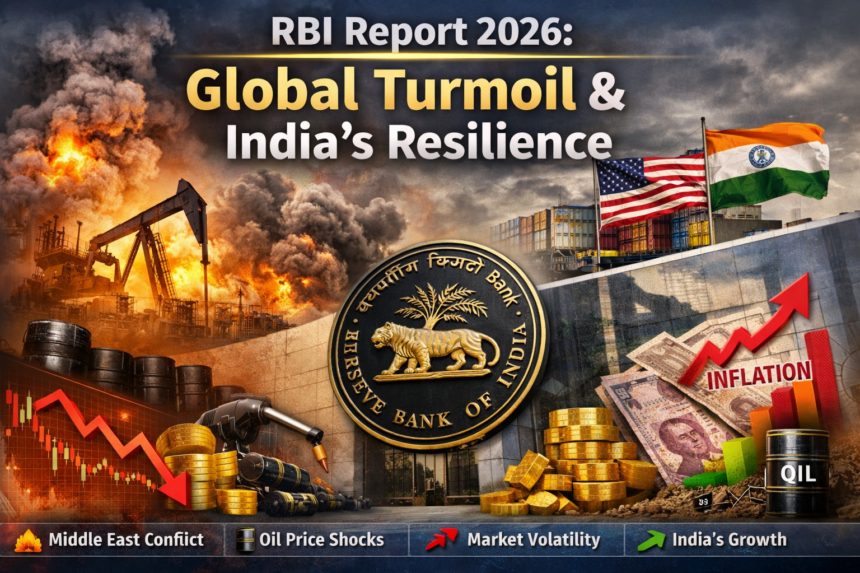
New Delhi, March 24: The Reserve Bank of India, in its March 2026 Bulletin, has highlighted a challenging global economic landscape characterized by rising uncertainty, even as India’s domestic economy continues to demonstrate resilience and stability.
The central bank noted that ongoing geopolitical tensions, fluctuating commodity prices, and slowing global growth have created a complex macroeconomic environment. Despite these external pressures, India’s economy has remained on a steady path, supported by strong domestic demand, stable financial systems, and prudent policy measures.
According to the RBI, key indicators such as consumption, investment activity, and infrastructure development continue to show positive momentum. The report also pointed out that inflation trends are being closely monitored, with efforts in place to maintain price stability while supporting growth.
The bulletin further emphasized that India’s banking sector remains robust, with improved asset quality and sufficient capital buffers. This has helped sustain credit growth across sectors, contributing to overall economic expansion.
While acknowledging global risks, the RBI expressed cautious optimism about India’s near-term outlook. It reiterated that continued policy coordination and structural reforms will be crucial in navigating uncertainties and sustaining long-term growth.
The Reserve Bank of India, in its latest assessment, has underlined that rising geopolitical tensions—particularly the escalating conflict in the Middle East and renewed trade actions by the United States—have led to heightened volatility across global commodity and financial markets.
The report highlights significant disruptions in energy markets, with supply shocks impacting crude oil, natural gas, and fertilisers. As noted by the International Energy Agency, the current situation represents one of the most severe supply disruptions in global oil market history. This has resulted in sharp fluctuations in crude prices and broader stress across commodity markets, which in turn has spilled over into financial systems. Global equity markets have weakened, bond yields have risen, and currencies in emerging markets have come under pressure amid increasing investor caution.
Despite these global challenges, India’s economy has shown strong resilience. Growth estimates for 2025–26 remain solid, supported by robust domestic demand. High-frequency indicators suggest that economic activity picked up pace in February, driven by both urban and rural consumption. Strong agricultural output, rising automobile sales, and steady expansion in the services sector have all contributed to this positive momentum.
At the same time, the RBI has flagged emerging inflation concerns. Retail inflation increased in February, largely due to a rise in food and beverage prices, especially vegetables. Additionally, global energy shocks are expected to create upward pressure on inflation in the coming months, as higher fuel costs and supply disruptions feed into domestic pricing.
On the financial front, conditions remain largely stable. Liquidity in the system is comfortable, supported by government expenditure and central bank measures, while bank credit and deposit growth continue to expand at a healthy pace. However, Indian financial markets have not been completely insulated from global developments. Bond yields have firmed up, equity markets have seen corrections, and the rupee has faced pressure due to foreign investment outflows linked to global uncertainties.
From an external perspective, India’s current account deficit has widened slightly, mainly due to a higher trade deficit driven by increased imports of petroleum products and gold. Nevertheless, the RBI has emphasized that the country’s foreign exchange reserves remain sufficient to buffer against external shocks, reinforcing overall macroeconomic stability.
Looking ahead, the outlook remains cautiously optimistic but dependent on global developments. While strong domestic fundamentals—including consumption, investment, and services growth—continue to support the economy, external risks remain elevated. Ongoing geopolitical tensions, volatile commodity prices, and tighter global financial conditions could pose challenges in the near term.
The RBI also noted that its current analysis does not fully account for the complete impact of the Middle East conflict, indicating that future data may reveal more significant effects. Overall, the report presents India as a resilient economy navigating a highly uncertain and volatile global environment, with clear implications for inflation, financial markets, and external balances.