


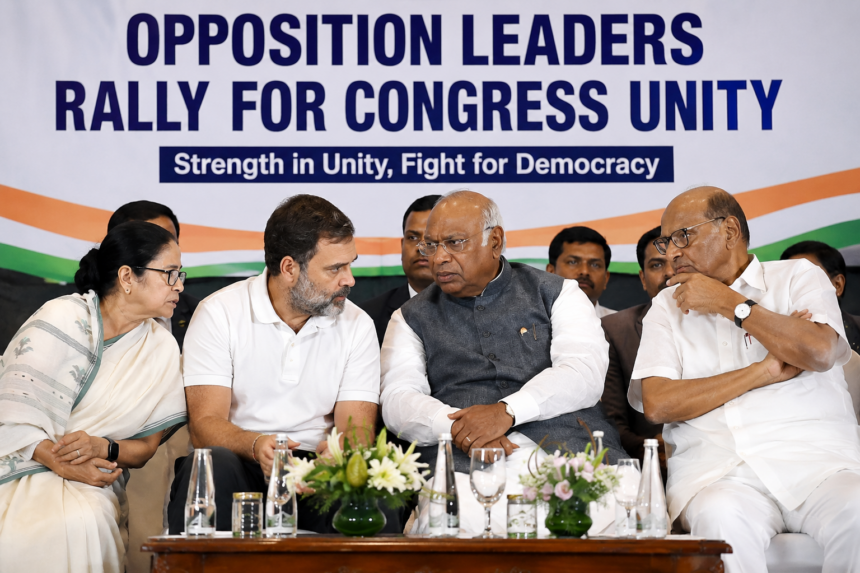
New Delhi: Opposition unity has once again become a major topic in Indian politics, with senior leaders from Congress and its INDIA bloc allies emphasizing the need for a strong and united opposition ahead of upcoming electoral battles. The spotlight is currently on West Bengal Chief Minister Mamata Banerjee and veteran leader Sharad Pawar, both of whom are seen as key figures in shaping the future of opposition politics.
Congress leaders have reiterated that the party must remain “Akhand” (united) and “Majboot” (strong) to effectively challenge the Bharatiya Janata Party (BJP). The call for unity comes at a time when opposition parties are attempting to strengthen coordination and present a common political strategy.
Congress Calls for Unity
Speaking at recent political meetings, Congress President Mallikarjun Kharge stressed that a united Congress is essential not only for the party’s future but also for strengthening the broader opposition alliance. Senior leaders, including Rahul Gandhi, have echoed similar views, highlighting the importance of cooperation among opposition parties.
According to Congress leaders, internal divisions and disagreements among opposition groups could weaken their collective strength and ultimately benefit the ruling BJP. Therefore, maintaining solidarity has become a key priority for the party leadership.
Mamata Banerjee’s Growing Importance
Mamata Banerjee, the Chief Minister of West Bengal and leader of the Trinamool Congress (TMC), remains one of the most influential opposition leaders in the country. Political observers believe her support and participation are crucial for any large-scale opposition strategy.
While the TMC has often maintained an independent political stance, recent developments suggest that Banerjee may play a more active role in promoting opposition coordination. Her political experience and strong regional influence make her an important player in shaping future alliance discussions.
Several opposition leaders believe that Mamata Banerjee can help bridge differences among regional parties and contribute to building a broader anti-BJP platform.
Sharad Pawar’s Strategic Role
Veteran politician Sharad Pawar continues to be regarded as one of India’s most respected political strategists. Known for his ability to maintain relationships across party lines, Pawar is often viewed as a consensus-builder within the opposition camp.
Political leaders from various parties have expressed confidence that Pawar can facilitate dialogue between Congress and regional parties. His experience and political network could prove valuable in strengthening opposition unity ahead of future elections.
Analysts suggest that Pawar’s involvement may help create a more coordinated approach among parties that often have differing regional interests but share common national concerns.
Challenges Before the Opposition
Despite the renewed calls for unity, several challenges remain. Regional parties have occasionally differed with Congress on state-level political issues, seat-sharing arrangements, and leadership questions. Balancing these interests while maintaining a united front will require careful negotiations and mutual understanding.
Opposition leaders have urged Congress to adopt a flexible and inclusive approach while dealing with alliance partners. Many believe that stronger cooperation and better communication are necessary to ensure the success of any opposition coalition.
What Lies Ahead?
As India moves closer to future electoral contests, the role of leaders like Mamata Banerjee, Sharad Pawar, Rahul Gandhi, and Mallikarjun Kharge is expected to become increasingly significant. Their ability to build consensus and maintain unity could influence the direction of opposition politics in the coming years.
For now, the message emerging from opposition circles is clear: a strong, united, and “Akhand Congress,” supported by a coordinated opposition alliance, is essential for presenting an effective challenge to the BJP and shaping the future political landscape of India.