


- Stop outgoing calls immediately.
- Allow incoming calls for a short grace period.
- Eventually block incoming calls as well. Why Incoming Calls Are Also Blocked
Many users assume that incoming calls should remain free forever. Technically, receiving calls may not be charged directly to the recipient. However, telecom companies incur infrastructure costs for:
- Network tower maintenance
- Switching and routing systems
- Spectrum licensing fees
- Customer data management
- Interconnection charges between networks
Even incoming calls consume network resources. Telecom providers argue that maintaining active numbers without recharge adds operational costs.
Therefore, they require a minimum recharge to keep the number active in the network system.
Regulatory Guidelines in India
Telecom services in India are regulated by the Telecom Regulatory Authority of India (TRAI).
According to telecom rules:
- Operators must provide a grace period after validity expires.
- SIM cards are not permanently deactivated immediately.
- Users typically get 15–30 days of limited service before full suspension.
- After extended inactivity (usually 90 days), the number may be permanently deactivated.
This policy ensures balance between consumer rights and telecom sustainability. The Grace Period Explained
After a prepaid recharge expires:
- Outgoing calls stop immediately.
- Incoming calls may continue for a limited grace period.
- SMS and data may also stop.
- If no recharge is done within the grace period, all services — including incoming calls — are blocked.
- Eventually, the SIM may be deactivated.
The grace period allows users time to recharge without losing their number immediately. Business Model of Telecom Operators
Telecom companies operate on revenue models based on:
- Active subscribers
- Average Revenue Per User (ARPU)
- Data consumption
- Voice usage
If millions of users keep SIM cards active without recharging, operators would face heavy financial pressure. Maintaining unused active numbers increases:
- Database storage requirements
- Network congestion
- Number resource exhaustion
Blocking services after non-recharge ensures that only active paying users remain on the network. Is It Legal to Block Incoming Calls?
Yes, it is legal under telecom licensing agreements.
When you purchase a SIM card, you agree to the company’s terms and conditions. These terms clearly state:
- Services depend on active validity.
- The company can suspend services if recharge is not done.
- The SIM remains subject to company policy and regulatory guidelines.
Thus, while you own the number registration, access to network services remains conditional. Common Misconception: “Incoming Calls Are Free”
Incoming calls are free for the receiver in most prepaid plans. However:
- “Free” does not mean “indefinite without validity.”
- It applies only when the number is active.
- Validity recharge keeps the SIM active in the system.
Without validity, the network does not treat the SIM as active.
What Happens If You Don’t Recharge for Long?
If you ignore recharge reminders:
- Your SIM enters suspension stage.
- Incoming calls stop.
- After prolonged inactivity (usually 60–90 days), the number may be permanently deactivated.
- The same number can be reissued to another customer.
This is why users are advised to recharge periodically to retain their number. Consumer Perspective
From a consumer standpoint, blocking incoming calls feels inconvenient because:
- Many people use their number for banking OTPs.
- The number is linked to Aadhaar, bank accounts, and social media.
- Losing connectivity can disrupt daily life.
Some users argue that minimum validity recharge costs are rising, making it harder for low-income users to maintain service. Telecom Companies’ Perspective
Telecom providers argue that:
- Spectrum costs are extremely high.
- Network maintenance requires constant investment.
- Free lifetime incoming service is financially unsustainable.
Over the past few years, telecom companies have increased minimum recharge plans to maintain profitability and invest in 4G and 5G expansion. How to Avoid Incoming Call Blockage
To ensure uninterrupted service:
- Keep track of recharge validity dates.
- Opt for long-term validity plans (3 months, 6 months, or annual).
- Set recharge reminders.
- Consider low-cost validity-only plans if data is not required. The Bigger Digital Dependency Issue
Today, a mobile number is more than just a calling tool. It is linked to:
- Digital payments
- Aadhaar authentication
- Government services
- Banking systems
- Social media accounts
Blocking incoming calls affects more than communication — it impacts digital identity access.
This is why many experts believe telecom policies must balance affordability with sustainability.Final Conclusion
Even though the SIM card and mobile phone belong to the user, telecom services operate under subscription-based access. Without an active recharge plan, operators are legally allowed to block incoming calls after a grace period.
Ownership of a SIM does not guarantee free lifetime network access. Instead, service validity ensures continued connectivity.
Understanding this distinction helps users make informed decisions and avoid unexpected service disruptions.
“lifetime free” incoming calls actually became largely obsolete around 2018–2019, rather than being new 5 years back (around 2021). Here is the breakdown of that transformation:
- The End of “Lifetime” Free (2018-2019): Before 2018, many users enjoyed lifetime validity on prepaid plans, where a single, small, or one-time payment allowed them to receive incoming calls indefinitely. By late 2018, major operators like Airtel, Vodafone, and Idea discontinued this, mandating minimum monthly recharges to keep receiving incoming calls.
- The “Jio Effect” (Post-2016): While Jio introduced free voice calls for life in 2016, they also required active, paid, data-centric plans. The shift was towards “All-in-One” packs rather than free, non-recharging lifelines.
- The 5-Year Context (2020-2021): Around 5 years ago, the focus was on the end of the IUC (Interconnect Usage Charges) regime. On January 1, 2021, Jio announced that all domestic off-net calls (calling other networks) would be free, bringing an end to the 6 paise per minute charge.
- Current Situation (2025-2026): Incoming calls are no longer truly “free” without any recharge. Major operators now typically block incoming calls and SMS within 24 hours to 30 days if you do not recharge
In summary, the “lifetime free incoming calls” model died out around 2018-2019, replaced by mandatory minimum recharges to keep the SIM active for incoming
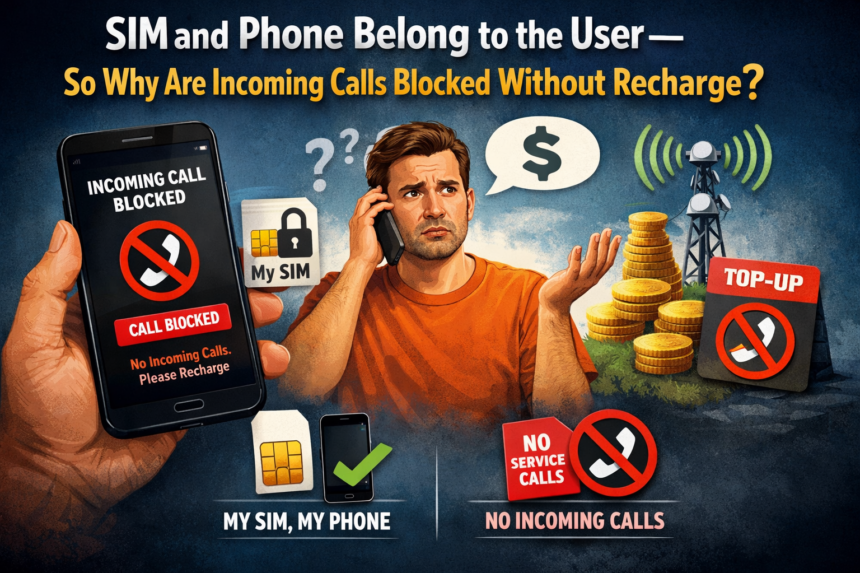
In today’s digital world, a mobile phone and SIM card are essential tools for communication, banking, business, and daily life. Many users often raise a common question: If the SIM and phone belong to the user, why do telecom companies block incoming calls when there is no recharge?
At first glance, it may appear unfair. After all, the SIM card is registered in the customer’s name, and the mobile device is personal property. However, telecom services operate under specific regulatory and commercial frameworks that explain why incoming calls may stop without an active recharge plan.
This article explores the legal, technical, and business reasons behind this issue. Ownership vs. Service Access
When a user buys a SIM card, it is registered in their name through Know Your Customer (KYC) verification. The mobile handset is also personal property.
However, there is an important distinction:
- You own the SIM registration and the device.
- You do not own the telecom network service.
Telecom companies provide network access as a paid service. The SIM is simply an authentication tool that allows you to access that network. Without an active service plan, the network provider can restrict certain functionalities — including incoming and outgoing calls. How Telecom Plans Work
Telecom operators in India typically offer prepaid and postpaid plans.
1. Prepaid Plans
In prepaid services:
- Users must recharge to activate validity.
- Validity includes access to network services.
- Once validity expires, services may be restricted.
2. Postpaid Plans
In postpaid services:
- Users receive monthly bills.
- Services continue as long as bills are paid on time.
In prepaid connections, when recharge validity ends, the telecom operator may:
- Stop outgoing calls immediately.
- Allow incoming calls for a short grace period.
- Eventually block incoming calls as well. Why Incoming Calls Are Also Blocked
Many users assume that incoming calls should remain free forever. Technically, receiving calls may not be charged directly to the recipient. However, telecom companies incur infrastructure costs for:
- Network tower maintenance
- Switching and routing systems
- Spectrum licensing fees
- Customer data management
- Interconnection charges between networks
Even incoming calls consume network resources. Telecom providers argue that maintaining active numbers without recharge adds operational costs.
Therefore, they require a minimum recharge to keep the number active in the network system.
Regulatory Guidelines in India
Telecom services in India are regulated by the Telecom Regulatory Authority of India (TRAI).
According to telecom rules:
- Operators must provide a grace period after validity expires.
- SIM cards are not permanently deactivated immediately.
- Users typically get 15–30 days of limited service before full suspension.
- After extended inactivity (usually 90 days), the number may be permanently deactivated.
This policy ensures balance between consumer rights and telecom sustainability. The Grace Period Explained
After a prepaid recharge expires:
- Outgoing calls stop immediately.
- Incoming calls may continue for a limited grace period.
- SMS and data may also stop.
- If no recharge is done within the grace period, all services — including incoming calls — are blocked.
- Eventually, the SIM may be deactivated.
The grace period allows users time to recharge without losing their number immediately. Business Model of Telecom Operators
Telecom companies operate on revenue models based on:
- Active subscribers
- Average Revenue Per User (ARPU)
- Data consumption
- Voice usage
If millions of users keep SIM cards active without recharging, operators would face heavy financial pressure. Maintaining unused active numbers increases:
- Database storage requirements
- Network congestion
- Number resource exhaustion
Blocking services after non-recharge ensures that only active paying users remain on the network. Is It Legal to Block Incoming Calls?
Yes, it is legal under telecom licensing agreements.
When you purchase a SIM card, you agree to the company’s terms and conditions. These terms clearly state:
- Services depend on active validity.
- The company can suspend services if recharge is not done.
- The SIM remains subject to company policy and regulatory guidelines.
Thus, while you own the number registration, access to network services remains conditional. Common Misconception: “Incoming Calls Are Free”
Incoming calls are free for the receiver in most prepaid plans. However:
- “Free” does not mean “indefinite without validity.”
- It applies only when the number is active.
- Validity recharge keeps the SIM active in the system.
Without validity, the network does not treat the SIM as active.
What Happens If You Don’t Recharge for Long?
If you ignore recharge reminders:
- Your SIM enters suspension stage.
- Incoming calls stop.
- After prolonged inactivity (usually 60–90 days), the number may be permanently deactivated.
- The same number can be reissued to another customer.
This is why users are advised to recharge periodically to retain their number. Consumer Perspective
From a consumer standpoint, blocking incoming calls feels inconvenient because:
- Many people use their number for banking OTPs.
- The number is linked to Aadhaar, bank accounts, and social media.
- Losing connectivity can disrupt daily life.
Some users argue that minimum validity recharge costs are rising, making it harder for low-income users to maintain service. Telecom Companies’ Perspective
Telecom providers argue that:
- Spectrum costs are extremely high.
- Network maintenance requires constant investment.
- Free lifetime incoming service is financially unsustainable.
Over the past few years, telecom companies have increased minimum recharge plans to maintain profitability and invest in 4G and 5G expansion. How to Avoid Incoming Call Blockage
To ensure uninterrupted service:
- Keep track of recharge validity dates.
- Opt for long-term validity plans (3 months, 6 months, or annual).
- Set recharge reminders.
- Consider low-cost validity-only plans if data is not required. The Bigger Digital Dependency Issue
Today, a mobile number is more than just a calling tool. It is linked to:
- Digital payments
- Aadhaar authentication
- Government services
- Banking systems
- Social media accounts
Blocking incoming calls affects more than communication — it impacts digital identity access.
This is why many experts believe telecom policies must balance affordability with sustainability.Final Conclusion
Even though the SIM card and mobile phone belong to the user, telecom services operate under subscription-based access. Without an active recharge plan, operators are legally allowed to block incoming calls after a grace period.
Ownership of a SIM does not guarantee free lifetime network access. Instead, service validity ensures continued connectivity.
Understanding this distinction helps users make informed decisions and avoid unexpected service disruptions.
“lifetime free” incoming calls actually became largely obsolete around 2018–2019, rather than being new 5 years back (around 2021). Here is the breakdown of that transformation:
- The End of “Lifetime” Free (2018-2019): Before 2018, many users enjoyed lifetime validity on prepaid plans, where a single, small, or one-time payment allowed them to receive incoming calls indefinitely. By late 2018, major operators like Airtel, Vodafone, and Idea discontinued this, mandating minimum monthly recharges to keep receiving incoming calls.
- The “Jio Effect” (Post-2016): While Jio introduced free voice calls for life in 2016, they also required active, paid, data-centric plans. The shift was towards “All-in-One” packs rather than free, non-recharging lifelines.
- The 5-Year Context (2020-2021): Around 5 years ago, the focus was on the end of the IUC (Interconnect Usage Charges) regime. On January 1, 2021, Jio announced that all domestic off-net calls (calling other networks) would be free, bringing an end to the 6 paise per minute charge.
- Current Situation (2025-2026): Incoming calls are no longer truly “free” without any recharge. Major operators now typically block incoming calls and SMS within 24 hours to 30 days if you do not recharge
In summary, the “lifetime free incoming calls” model died out around 2018-2019, replaced by mandatory minimum recharges to keep the SIM active for incoming